


Journal · · 3 min read
Lapis, malachite, carnelian: a guide to the stones of pietra dura
The natural palette of inlaid marble: lapis lazuli, malachite, carnelian, mother-of-pearl, onyx and more, and what each stone brings to a design.
In pietra dura there is no paint. Every colour is the colour of a stone, chosen for its hue, its figure and the way it takes a polish. These are the stones we use most, and what each one brings.
White Makrana marble
The ground of most of our work: bright, fine-grained and luminous, the marble of the Taj Mahal and a designated Heritage Stone.
Lapis lazuli
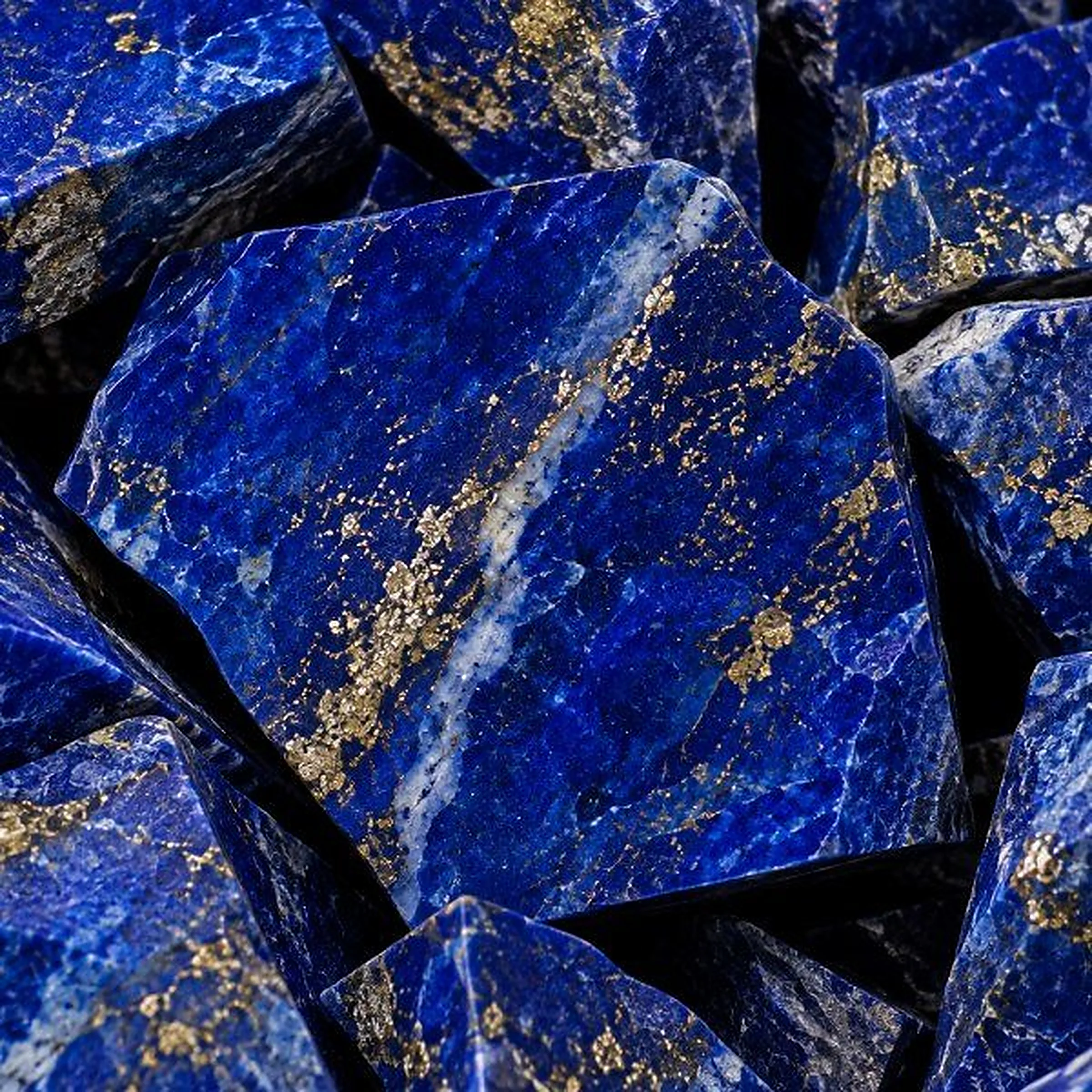
The deepest natural blue, often flecked with gold pyrite. Prized for centuries, and once ground to make the ultramarine of Renaissance painting. In inlay it gives the blue of petals, borders and calligraphy.

Malachite
A vivid green banded in concentric rings. Its figure can be cut to follow the curve of a leaf, or used in broad fields for a table top of startling depth.
Carnelian and red jasper
Carnelian is a translucent red-orange chalcedony that glows when light passes through it; red jasper is opaque and earthier. Between them they give the reds at the heart of a flower and the warmth of a Gulf sunset.
Mother-of-pearl and abalone
Shell rather than stone, but central to the craft. Mother-of-pearl gives a soft, shifting white; abalone a blue-green iridescence that changes as you move around the piece.
Turquoise
A sky blue to blue-green, used for small, bright accents.
Onyx
Banded and often translucent, from honey to green. Thin onyx can be backlit, so that a wall or panel glows from within.
Green, black and coloured marbles
Deep greens and blacks make dramatic grounds for night gardens and calligraphy; pinks, yellows and reds widen the palette for landscapes and skies.
Choosing stones
No two pieces of natural stone are identical, which is the point. For every commission we prepare samples of the actual stones proposed, and nothing is cut until they are approved.